Augustine: The City of God against the Pagans (Cambridge Texts in the History of Political Thought) by Augustine
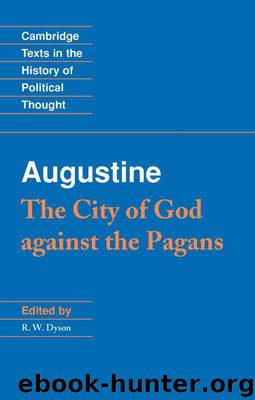
Author:Augustine
Language: eng
Format: epub
Publisher: Cambridge University Press
Published: 1998-09-24T00:00:00+00:00
The act itself which is performed under the influence of such lust shuns the public gaze. This is true not only of those debaucheries which need places of concealment in order to escape the reproach of human judgment, but also of the practice of fornication, which the Earthly City has made into a lawful form of wickedness: a kind of lust which is permitted and not punishable by any law of that City. A natural sense of shame ensures that even brothels make provision for secrecy; and it was easier for unchastity to dispense with the fetters of prohibition than for shamelessness to abolish the hiding-places of this filthiness.
Whoring, indeed, is called wicked even by those who are wicked themselves: who, even though they are lovers of it, dare not show themselves to be such. But what of marital intercourse, the purpose of which, according to the prescriptions of the marriage-contract, is the procreation of children? This is lawful and honourable, indeed; but does it not still require a private chamber remote from witnesses? Before he begins even to caress the bride, does not the bridegroom first send away all the servants, and even his attendants and all the others who have been permitted to enter because of some tie of kinship? As a certain ‘supreme master of Roman eloquence’142 says, all right actions wish to be placed in the light of day: that is, they desire to be known.143 And this right action, too, desires to be known, even though it blushes to be seen; for who does not know what act is performed by a married couple for the procreation of children, when all the ceremonies involved in the taking of a wife point towards that act? Nevertheless, when that act is actually being performed, not even the children who have already been born from it are permitted to witness it. This right action desires recognition by the light of the mind, but it nonetheless shuns the light of the eye. Why is this, if not because something which is by nature decent is performed in such a way as to be accompanied by shame, by way of punishment?
Download
This site does not store any files on its server. We only index and link to content provided by other sites. Please contact the content providers to delete copyright contents if any and email us, we'll remove relevant links or contents immediately.
The Secret History by Donna Tartt(19017)
The Social Justice Warrior Handbook by Lisa De Pasquale(12180)
Thirteen Reasons Why by Jay Asher(8880)
This Is How You Lose Her by Junot Diaz(6868)
Weapons of Math Destruction by Cathy O'Neil(6257)
Zero to One by Peter Thiel(5778)
Beartown by Fredrik Backman(5726)
The Myth of the Strong Leader by Archie Brown(5489)
The Fire Next Time by James Baldwin(5421)
How Democracies Die by Steven Levitsky & Daniel Ziblatt(5207)
Promise Me, Dad by Joe Biden(5138)
Stone's Rules by Roger Stone(5073)
A Higher Loyalty: Truth, Lies, and Leadership by James Comey(4944)
100 Deadly Skills by Clint Emerson(4909)
Rise and Kill First by Ronen Bergman(4766)
Secrecy World by Jake Bernstein(4735)
The David Icke Guide to the Global Conspiracy (and how to end it) by David Icke(4694)
The Farm by Tom Rob Smith(4498)
The Doomsday Machine by Daniel Ellsberg(4477)
